
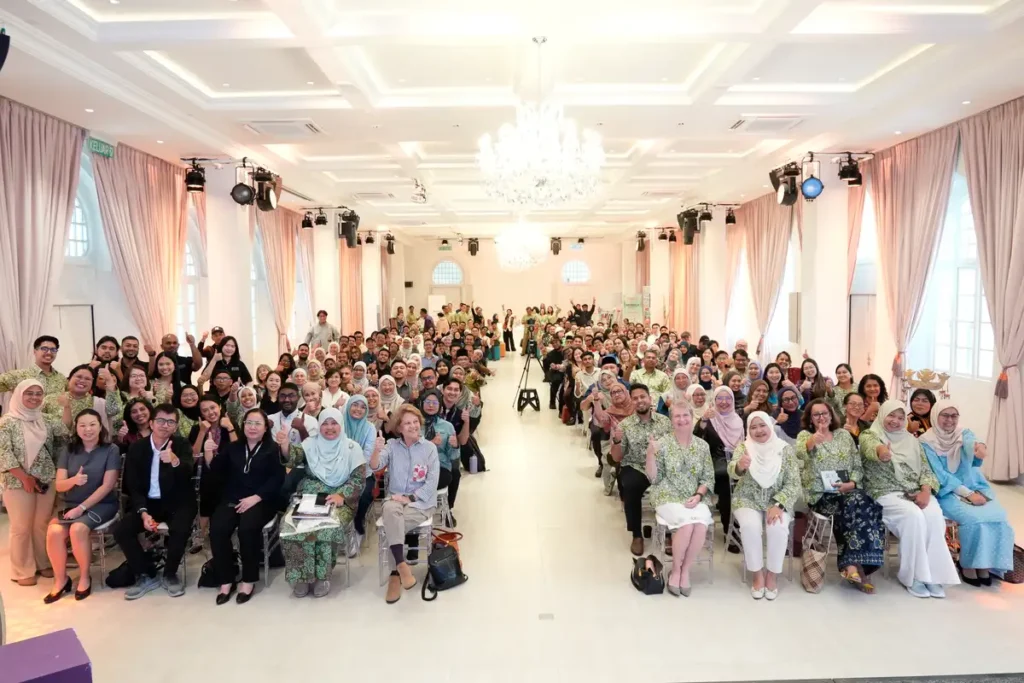
To mark Yayasan Hasanah’s 50th ILMU session, we reflect on how knowledge has shaped the organisation’s evolution over nearly a decade of collaboration with communities and partners nationwide. Since 2017, ILMU Hasanah has grown into a space where community champions and policymakers sit side by side. Where environmentalists and educators find common ground. Where stories are told, assumptions challenged, and learning becomes something you can feel.
Held at the historic Sultan Abdul Samad Building at Dataran Merdeka, the event also commemorated Malaysia’s 69th year of independence. Six inspiring individuals from across sectors came together under the theme Merdeka Through ILMU: Advancing Malaysia Together – each one working toward a better Malaysia. Sarinah Said, founder of Lambo Sari Resources, reflected on cultural heritage preservation. Rahman Imuda from Kromium Digital, shared insights on education access and inclusion. Imelda George from Good Shepherd Services Malaysia addressed the protection of women and children from domestic violence. Sarina Mokhtar from Sunshine Qualicare Sdn. Bhd. spoke on ageing and palliative care. Ruth Yap from Zero Waste Sabah discussed sustainable waste management. Finally, Dr. Sarena Che Omar from PNB Research Institute spoke on food security and national resilience.
What Is Culture, If Not Loved?
As consumer habits shift and the world speeds up, many of Malaysia’s traditional crafts face an uncertain future. When Sarinah Said spoke on heritage and culture, she did not address them as relics of the past, but as living threads woven into our everyday lives. From the Wau logo of our national airlines to the designs of our homes, she identified six pillars of Malaysian identity: weddings, performances, food, games, crafts, and architecture. While consumption is shifting toward factory manufacturing, skilled crafts are being left behind. And because young people are the least involved in traditional crafts, Sarinah organises cultural festivals where attendees can learn not just the techniques, but the histories behind them. “Perpaduan ini tidak berlaku begitu sahaja – ia perlu dibentuk, diasuh, dan dipelajari. Dengan pemahaman terhadap budaya dan identiti warisan kita, kita dapat menghormati dan meraikan bersama” (Unity does not happen on its own – it must be built, nurtured, and learned. Through understanding our cultures and shared heritage, we can respect and celebrate them together), she said, reminding us that our culture stays alive only when we remain open to experiencing it.
Football for Education
According to the Sabah Child Wellbeing Index, only one in four children meets the learning wellbeing standard, despite more than 90% of children aged 6–17 attending school. Rahman Imuda from Kromium Digital shared a story about the barriers holding children back. His presentation, Jarak Kanak-Kanak dengan Peluang, identified four key obstacles faced by children in Sabah: geography, income, documentation, and confidence. Even among those in school, many fall behind due to disengagement. What struck Rahman was the shift when children played sports – kids who never spoke in class came alive on the field, happy to try, fail, and try again without fear. This led to teaching methods that prioritise interactive, playful activities over one-way instruction. This approach has helped keep children engaged in lessons – even when held by the roadside.
Between Freedom and Violence
Cases of domestic violence have increased from over 5,000 recorded cases in 2023 to over 7,000 in 2025 – the actual number is likely much higher, as many incidents go unreported. Imelda George opened with a sobering reflection: “Violence is not our culture, but silence will allow it to become one.” On a day celebrating Merdeka, she challenged the audience to consider what independence truly means for individuals: safety and dignity. “If violence is learned, then respect can be learned too,” she said. It is not enough to teach people not to practice physical violence – we must also extend compassion to those whose situations we cannot fully understand. For Malaysia, this means strengthening support systems for survivors, reforming legal frameworks, and fostering a culture where silence is no longer an acceptable response.
The Future of Ageing is Now
With Malaysia projected to become an aged nation by 2040, and Ipoh already home to a 14.9% ageing population, the need for trained caregivers and accessible palliative care is urgent. Sarina Mokhtar founded Sunshine Qualicare in Ipoh after her own experience as a caregiver to her parents and husband. She spoke candidly about the doubt and anxiety she faced, wondering if her care was good enough, or if she might accidentally hurt her loved ones. Her experience is far from unique. “The future of ageing is not someone else’s problem,” she said. “It is our future too. Let’s build a future we want for ourselves.”
Making a Sustainable Malaysia
Waste management in Sabah and Sarawak faces major hurdles – vast geography, rapid urbanisation, and infrastructural gaps. Both states struggle with overflowing landfills, uneven rural collection, and regulatory frameworks that differ from Peninsular Malaysia. For the past seven years, Zero Waste Sabah has been addressing the lack of waste collection systems in remote and rural communities across the region. The answer to the complexities of waste collection lay in the community itself. Three pillars were essential: education, community action, and policy change. With the goal of making sustainable living easy and accessible, Zero Waste Sabah brought together community members, CSOs, funders, and government agencies – training market vendors, installing information boards, and empowering local leaders to implement zero-waste operations. The model offers a blueprint for other regions across Malaysia facing similar challenges.
Rice, Research, and National Resilience
Malaysia spends over RM2.6 billion yearly on rice subsidies, yet produces only 53% of its own needs – making it one of the most heavily regulated food commodities in the world. Dr. Sarena Che Omar, a researcher with decades of experience, explained that building a nation demands deep knowledge, and food security is central to that. For Malaysia, food security is a matter of national sovereignty – not just agriculture. Modernising farming, supporting smallholder farmers, and strengthening local supply chains are essential to reducing import reliance and ensuring access to affordable, nutritious food. Yet despite modernisation, most farms still rely on buffaloes and manual labour. Knowledge alone is not enough, she emphasised – it must be paired with trust, collaboration, and cross-sector cooperation. Progress depends on active partnership between the public, government, and academia.
Looking Forward: ILMU as the Foundation of Progress
As Malaysia celebrates 69 years of independence, ILMU Hasanah reminds us that freedom is not just about the past – it is about the future we build together. What began as a series of conversations has grown into a living ecosystem of exchange, where knowledge is not just shared, but shaped, tested, and refined by those who use it. The 50th session was not a conclusion, but a continuation – a reaffirmation that progress depends on our willingness to listen, learn, and act.
To learn more about the conversations that shaped this milestone, scan the QR code below to download the 50th ILMU publication.