
In a global marketplace saturated with mass-produced goods, a quiet but powerful movement is growing. Today’s consumers are increasingly seeking more than mere products; they are searching for authenticity, story, and connection. This shift presents a vital opportunity for Malaysia’s rich tapestry of heritage crafts. The true heart of this cultural wealth lies not in the objects alone, but in the vibrant communities of artisans and their techniques which keep these traditions alive. Their work is a profound cultural expression, embedding history, identity, and artistry into every piece. By empowering and centering these crafting communities, Malaysia can preserve its irreplaceable heritage while meeting a modern demand for meaning, ensuring that classical skills not only survive but thrive in the contemporary market, both at home and abroad.
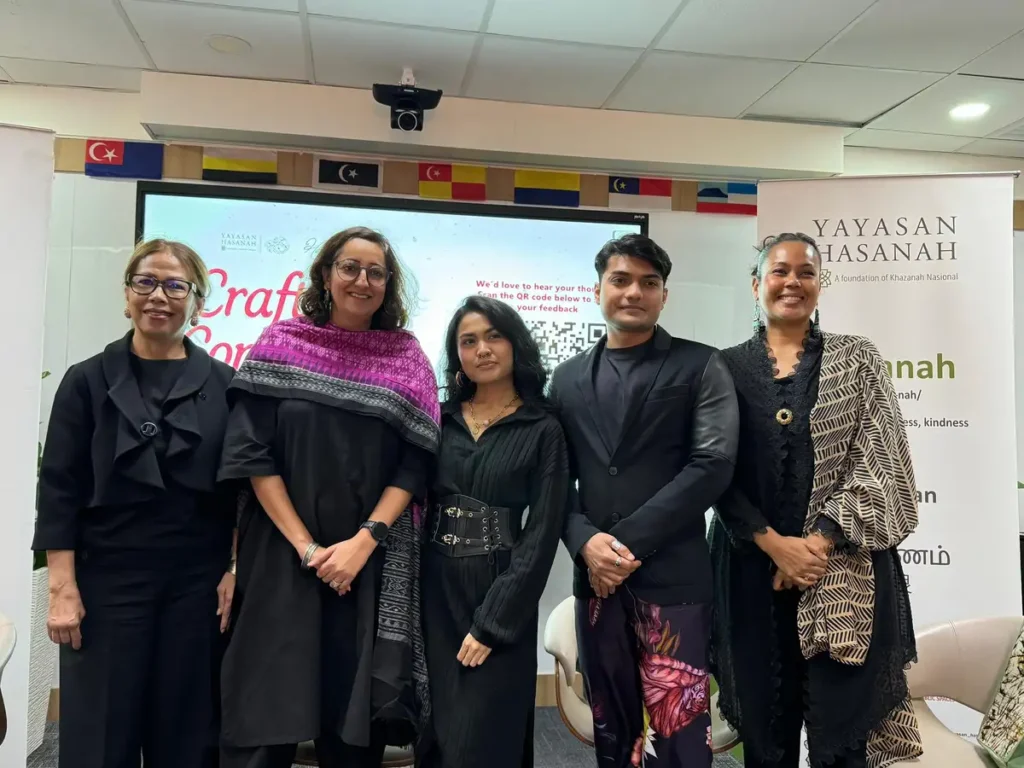
At Yayasan Hasanah’s 48th ILMU session, three pioneers in artistic collaboration came together to discuss a vital question: how can agencies and brands preserve the depth of cultural expression? Moderated by multi-artist Nini Marini, Head of Arts and Public Spaces at Hasanah, the conversation flowed with stories and lessons from Adlina Borhan, CEO & Co-Founder of the Paris-based consultancy Ab & Artho; multidisciplinary artist Haris Rashid, whose work engages with cultural elements both locally and internationally; and Shafiqah Othman, Regional Creative Director of ZUS Coffee, who leads the brand’s storytelling.
In her opening, Nini highlighted a critical tension: while demand for cultural art is high, it is not always met with respect for the generations of creativity and refinement behind each craft. “If we don’t tell our stories,” she noted, “someone else will, and they might not get it right.”
Building Connection Through Art
Malaysian art holds great potential – not only to display its own rich culture, but to amplify the global art scene with a unique twist that is unmistakably local. Adlina explained that introducing a Malaysian perspective in Paris wasn’t easy at first. What helped, she found, was establishing a human connection – helping people understand what could be created through honest collaboration. She recalled one of her most meaningful exhibitions, where she brought a piece of Kelantan to Paris. With determination, she was able to display the creativity, resilience, and beauty of Malaysian heritage – and how it can inspire exceptional work.
When the meaning behind these works are laid out, whether through story-telling or performances, audiences often connect with the products in a deeper, more meaningful way. If handled thoughtfully, this can cultivate a consumer market that becomes more conscious of its own rich history and the lived experiences that fuel creativity. Brands like ZUS Coffee are already embedding this value by engaging local artists and providing them a platform to express themselves. This not only expands the artists’ reach into new sectors, but also inspires others to evolve their craft in ways that can keep pace with – and contribute to – the accelerating global marketplace.
Authentic Expressions in a Commercialised Market
“We want to define what makes us buatan Malaysia,” said Shafiqah. “When we include heritage in our branding, we don’t want to use an old story that feels nostalgic rather than relevant. That’s why it’s so important to understand current narratives which represent the living culture that holds communities together. That’s the story we want to tell, one that makes people feel connected and inspired to journey through their own history and appreciate it.” The method, she explained, is to capture one of the many colours that define us, turning these moments into tangible pieces that can evolve even further – not just narrating a story to sell.
Authenticity isn’t always easy, especially when brands come with fixed ideas and seek cultural input merely to be trendy or profitable, putting artists in a dilemma. This is where their personal resilience to safeguard the integrity of their work comes into play. But as every panelist echoed, this isn’t a moment for conflict – it’s a moment for respect. It’s about explaining why staying true to the art matters, and guiding clients toward wanting the same because there is no right or wrong in cultural expressions, there is only understanding. Haris reflected that opening people’s minds to new ideas is part of what makes Malaysians unique: “We are Malaysian – we make sense of a lot of things that don’t make sense to the outside world, and we make it look harmonious. Changing minds is part of our culture”
Communities Forge Cultural Heritage
Culture is a continuous process – it creates the heritage we carry as our identity. Ultimately, it is not brands or institutions that steer the celebration of cultural heritage, but Malaysians themselves. The responsibility lies with us to keep understanding where we come from and to thoughtfully weave that history into our lifestyles and creative education. Supporting artists and creating spaces for them to develop their work is how we, as a community, ensure cultural understanding flows through diverse channels that we can consume – whether its through the beats of the kompang, the style of the songket, or the graceful movements of Mak Yong. The beauty of such diverse expression is that it carries no fixed expectation. When embraced authentically, its only limit is potential.
While some nations champion their heritage outwardly, their own communities may feel disconnected from it as a lived identity. This is where Malaysia can chart a different path. Walk down any street, and you might spot someone wearing traditional patterns not as a costume, but as a part of their day. This points to a strong, embodied relationship with culture – a diversity that is not just seen, but lived. The task is to tell the true stories behind these expressions, inspiring lifelong appreciation rather than offering a bite-size “experience” of our culture. As Visit Malaysia 2026 approaches, inviting travellers to our homeland, we have the chance to reflect: how do we wish to be seen? “Crafting Community” is the hope that, together, we can weave the threads of Malaysia’s diverse heritage into a coherent tapestry that we exhibit as our own – one that truly reflects the essence of who we are.