
October 2025 saw a major tipping point for climate change, where the loss of all our coral reefs – a major habitat for thousands of aquatic species – became irreversible. Even for those who want to care, the path forward is unclear. This global phenomenon has become abstract for many, while only frontliners and people from high-risk areas feel its concrete and undeniable effects. Nonetheless, climate reports have had a major impact on individuals, with a greater weight on young people. On one hand, it feels impossible to single-handedly save the environment; on the other, we often don’t know where to start, and so we don’t start at all. What is now termed “eco-anxiety” is very real and very worrying.
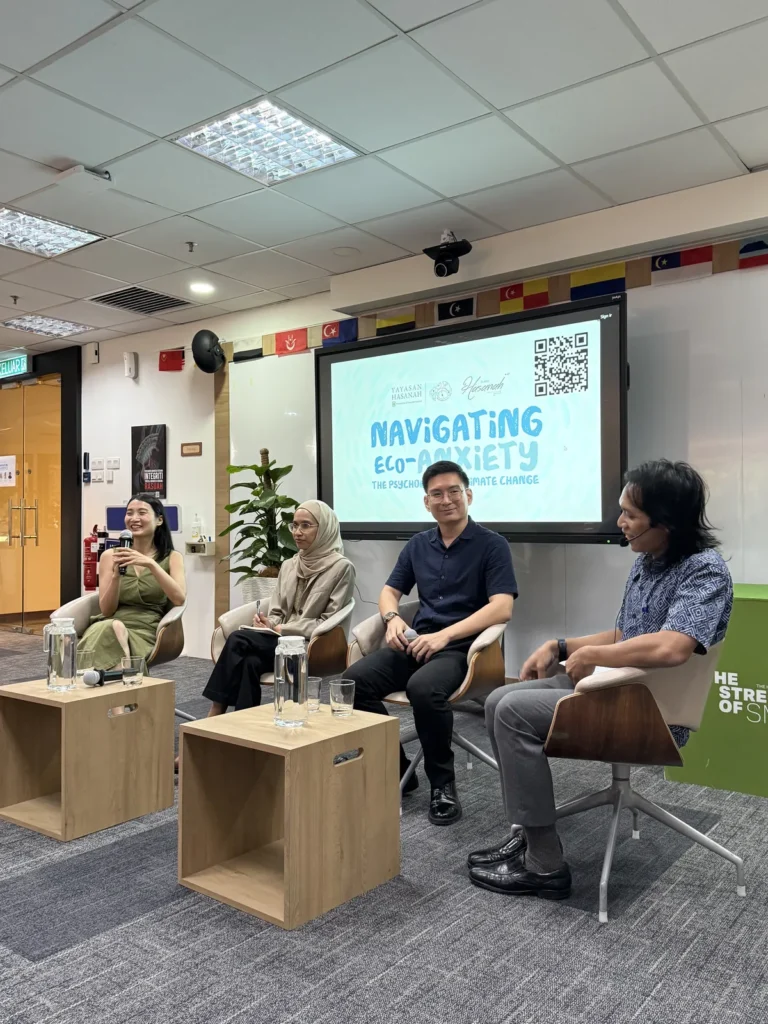
Hanasah’s 46th ILMU session brought together frontliners in the battle against environmental degradation, all of whom shared insightful knowledge on perseverance as nature’s custodians and resilience in the little things we can do for the planet without feeling overwhelmed or burnt out. In his opening remarks, Prof Datuk Dr. Andrew Mohanraj from the Malaysian Mental Health Association (MMHA) talked about Malaysians from high-risk areas around the country who are constantly distressed by impending floods or heatwaves. “It used to be a once-a-year phenomenon, where you were not sure if it was going to be mild or devastating,” he noted. “However, over the past few years, it can happen multiple times a year, making it a major source of anxiety, fear, grief, and helplessness.”
Eco-anxiety is not a mental illness, the same way mass anxiety during a war wouldn’t be blamed on the individuals. It is simply that some people are far more aware of the losses that are already occurring. Sure, we can say that eventually it will hit closer to home and then maybe something might be done, but the truth is, many species have already suffered and are continuing to suffer the consequences of excessive development and our lack of guardianship. Rivers are already running poisonous and killing aquatic life, deforestation is already starving thousands of creatures, and the mounting waste we produce has become a seemingly unstoppable tide.
The Weight of Witnessing
The groups of people who have had to witness this deterioration firsthand – whether villagers, indigenous communities, or environmentalists – are often left feeling helpless. Dr. Ooi Wee Liam from Environmental Humanities and Social Sciences at Monash University Malaysia emphasised that the environment needs all the help it can get. He suggested that a million people doing a little bit to save whatever they can (even saving five minutes of running water) can make a bigger difference than five people doing everything perfectly. As we navigate the transformation towards sustainability, human consumption does not pause, and that is precisely where we need to make a difference.
Hanis Alwani, the focal point of the Malaysian Youth Delegate, highlighted the massive waste that Malaysians produce in a single day, which makes young people feel helpless and guilty over their inability to make a real difference. A report by Urbanice Malaysia found that 1.9% of plastic waste, equivalent to 8.4 tonnes, is littered and leaked each day in Kuala Lumpur alone. While many institutions have initiated programmes to address the growing issues, these programmes often lack collaborative efforts with the communities themselves, preventing them from contributing, learning, and taking ownership of their surroundings. In many flood-hit areas, like the recent floods in Klang, massive cloggings had to be cleared by the community because it was their roads and their homes that were affected. A viable and traditional activity that we all share as Malaysians is gotong royong, a Malay term translating literally to ‘jointly carrying burdens’ – which is exactly what we need to do before tragedy hits.
When discussing the effects of feeling useless in the face of a deteriorating environment, Jolene Tan, founder of GreenWeive, explained that people tend to create psychological distance from the issue just to get through the day without considering the planet’s future doom. This is a not hitting us every day, it’s still hitting other people, wildlife, and the very atmosphere we breathe. On a grand scale, it would take the whole world to save the earth, but in reality, every individual can play a role with a profound effect. The trick is to consider the survival of the very place you are in, rather than focusing on everybody else’s role. This requires emotional resilience that we have to address within ourselves because there is no KPI to reach here, only a consistent and continuous effort to improve. When we are present in our respective circumstances, we can lower burnout, transform anxiety into action, and be at peace with our own capacity.
Reclaiming Agency through Community Action
In addressing media coverage of natural disasters around the world, one must consider that sensationalising news is a primary goal of the media, which is not at all helpful for the individual trying to make a difference. Pointing fingers or blaming corporations is useless if there are no action plans behind every report. As Malaysians, we have a duty to pay attention to the local issues around us, whether it’s clogged drains, air pollution, or deforestation, by joining forces or creating movements that empower the community to decide and change what is not working for the environment and its future. While there may be many people who choose not to do anything or deny its occurrences, that is not a good reason for us to also ignore the problem.
Navigating eco-anxiety begins with acknowledging that this grief and fear are a testament to our capacity for care, not a personal failing. The path forward is not about carrying the world’s burden alone, but about embracing the power of collective, local action. Start small: conserve water, participate in a gotong royong, or support a community garden. Channel the energy of your anxiety into these tangible acts, and remember the wisdom shared by the experts: a million small actions create a far greater wave of change than a few perfect ones. Be kind to yourself, celebrate the small victories, and draw strength from your community. The challenge is immense, but so is our capacity for resilience, innovation, and care. Your actions, however small they may seem, are a vital part of the solution and a powerful affirmation of hope for our shared future.