
The movement of refugees across the world is a phenomenon that’s been happening for decades, even centuries. Some flee from war and persecution, while others from poverty and exploitation – this journey gets even more complicated when children are involved. There is an estimate of 40,000 refugees and 290,000 undocumented children of schooling age in Malaysia, facing severe learning disruptions. Thankfully, the compassion of many Malaysians and a few governmental leeways has allowed them to access alternative learning programmes that are continuously trying to equip them with the knowledge and skills needed for their survival.
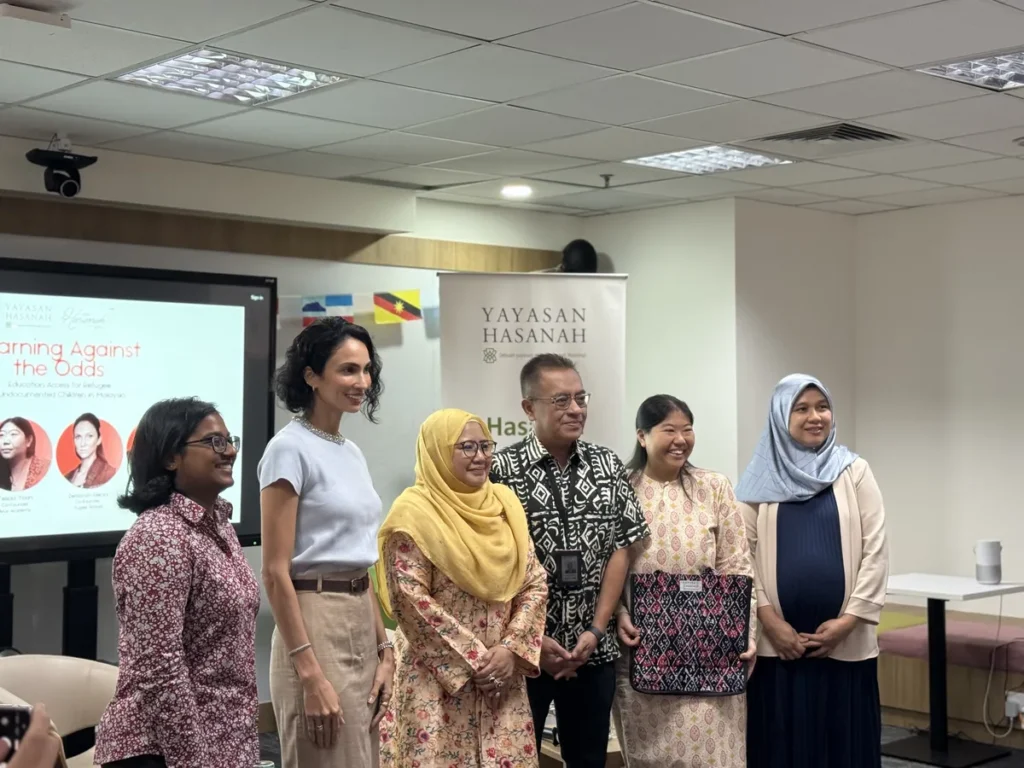
During a panel discussion at Hasanah’s 45th ILMU session, we delved into the complexities of this very topic with representatives from four organisations and institutions involved in providing education to refugees and undocumented children; United Nations High Commissioner for Refugees (UNHCR), Arus Academy, and Fugee School. In a panel moderated by Davina Anne Rajah, a representative from Architects of Diversity, UNHCR’s Head of Education, Fairuz Alia Jamaluddin explained that the main role of the organisation is to safeguard refugees in Malaysia by issuing identity cards which provide protection from authorities until they are relocated. However, there is zero pathway for refugees to gain citizenship or special work permits from the government of Malaysia while undocumented children (sometimes referred to as stateless) have a very small chance of gaining citizenship.
Perception and Funding: The challenges of Alternative Learning Centres (ALCs)
In her opening remarks, Puan Siti Kamariah, Managing Director of Hasanah, talked about education being a fundamental tool to break cycles of poverty and because refugee and undocumented children are denied a nurturing and conducive learning environment, a question like “what do you want to be when you grow up”, turns into a luxury. Many of these children are eager to find a way to be trained as doctors or teachers so they can help those that have faced the same difficulties, whether in Malaysia or back in their own country. She explained that prejudice is the main barrier that is stopping national interventions for the undocumented population. A sentiment that Davina echoed in a survey report on discrimination and social cohesion, which found that 31% of Malaysians believe that refugees should not be given the right to work, while the remaining 69% want to see better integration, but have no idea what that would look like.
Integration of refugees and undocumented children into Malaysian culture and economy is not an easy feat yet, it is not impossible either. Deborah Henry, co-founder of Fugees stated that a conversation like this was not even possible five years ago, so even if we move the needle one inch at a time, we are still heading in the right direction – although it can cost millions. Many private companies and citizens have made schools like Fugee and Arus Academy possible through donations, volunteering and training. Felicia Yoon, the co-founder of Arus Academy highlighted the challenges that undocumented children face, where some may get their documentation eventually but then cannot integrate with the national schools because years of delay have put them way behind, forcing them to drop out anyway. Teachers are also not equipped with the resources and expertise to accommodate these types of students in national schools.
A survey of 30 Alternative Learning Centres (ALCs) found that many teachers helping to educate these undocumented and refugee children are severely underfunded, with some teachers taking home RM 200 a month while catering to dozens of students. Learning modules are also limited due to the unique nature of these students’ circumstances, while resources are also lacking. But the students themselves never give up hope. Felicia learned about the daily challenges of her students who explained to her that even getting a phone number, travelling by bus, or visiting friends in gated areas requires identity cards – these barriers seem to be present in all aspects of their lives, beyond just education and employment. Every time a child misses out on education, the country loses, that was the sentiment that was felt in the room while hearing the stories of children and their families navigating survival and knowledge through unshattering resilience.
Implementing sustainable policies
To streamline alternative learning centres across the country, a resource bank filled with modules, guidelines and curriculum needs to be established to improve the effectiveness of programmes and ensure that those with no choice, still have an opportunity to expand intellectually. The Sekolah Bimbingan Kasih established under the zero-reject policy have provided some opportunity for undocumented children to attend school, provided that at least one parent has an IC. Even among these students, the chances of the child receiving proper documentation for their citizenship is extremely rare with no opportunity at all for refugee children. With working rights also denied to their parents, many remain unemployed and desperate to establish a better future for their children. Deborah pointed out that millions of migrant workers are brought into the country every year yet the obvious solution of meeting worker demands with our refugee population of merely thousands is deliberately ignored. Many of our refugees come from Myanmar, highlighting the need for a regional solution that can be mutually beneficial for Malaysia and refugees seeking a better life and a chance to prove themselves.
Countries such as Turkey, Lebanon and Thailand have adopted unique strategies to accommodate their refugee population. Thailand for instance, implemented the Bangkok Metropolitan Administration (BMA) schools which allows all non-citizen children to enrol while also ensuring funding through the Equitable Education Fund (EEF) for private companies to donate and receive tax rebates in return. Adopting a similar model would provide sustainable educational support for these children, building a foundation for a more inclusive and unified future for all who call Malaysia home.