
Disaster Management in Malaysia
Between November 2024 and March 2025, floods in Malaysia affected 274,533 people, according to the National Disaster Management Agency (NADMA). The devastation was concentrated in three states – Kelantan (40.3%), Terengganu (24.4%), and Sarawak (11.5%) – where rising waters submerged homes, roads, and livelihoods. While survival rates remain high, the aftermath has left a multibillion-dollar burden on state governments, federal agencies, and local communities. Extreme weather, from relentless storms to scorching heatwaves, has become a disruptive force in daily life. A four-day downpour, once manageable, now unleashes destruction that takes months or even years to repair. Disaster preparedness is no longer just a reactive measure; it is a preventative strategy that demands integration of community infrastructure, environmental stewardship, and climate adaptation.
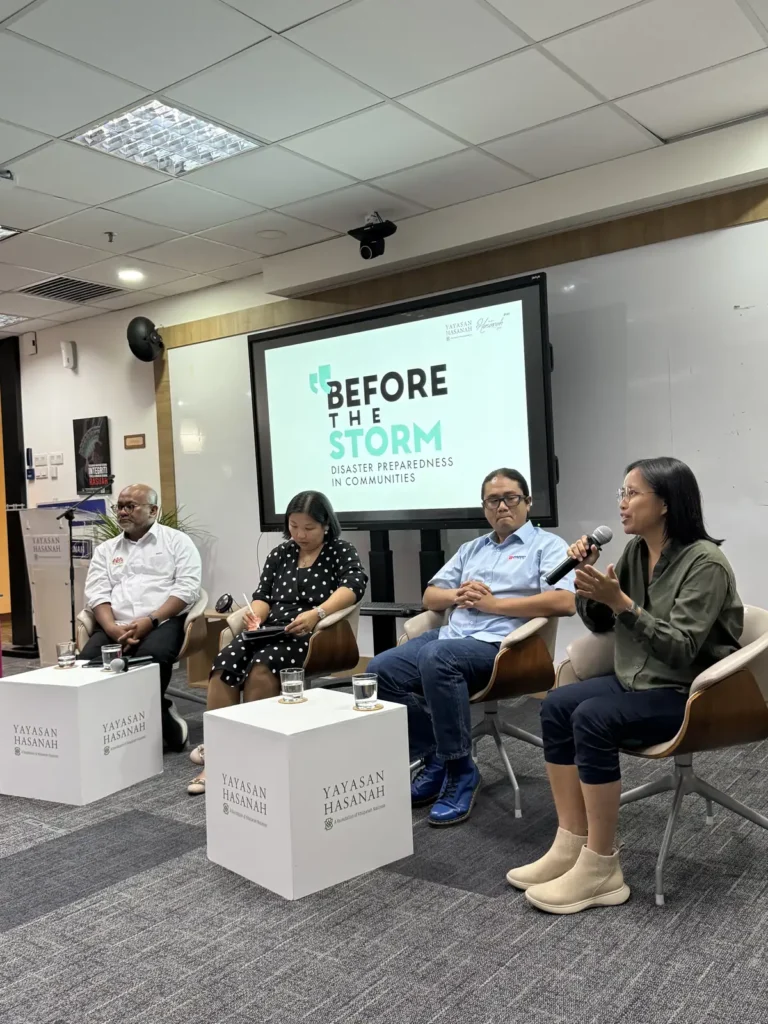
At Hasanah’s 44th ILMU session on Disaster Preparedness, representatives from NADMA, MERCY Malaysia, C40 Cities, and Gerimis Art gathered to share their knowledge on what true resilience means for communities. Mohammad Faizal, Senior Principal Assistant Director at NADMA presented shocking data on crisis response costs and its increasing occurrences around the country. For example, evacuating and feeding 270,000 flood victims costs RM4 million per day – a figure that excludes search and rescue, logistics, damage repairs and other infrastructural support.
Since the catastrophic floods of 2014, which displaced over half a million people, Malaysia has strengthened its disaster response systems by establishing NADMA. Their central role in disaster response is to ensure streamlined management and coordination with other agencies, international bodies and Civil Society Organisations (CSOs). Yet effective crisis management hinges on public cooperation. Well-intentioned but uncoordinated efforts – such as delivering 500 meals to a shelter of 1,000 victims can strain resources rather than relieve them. Volunteers must therefore align with registered NGOs and agencies, ensuring aid is equitable and logistically viable before mobilising support.
Building Resilience Nationwide
To further maximise its reach and resources, NADMA launched the GDRN Network (Government-Linked Companies Disaster Response Network), a collaborative platform that streamlines aid distribution between government-linked entities, NGOs, and CSOs. By coordinating efforts, the network ensures no assistance is duplicated or wasted in the disaster response, which can sometimes last for months. Mohammed Faizal emphasised that every RM1 spent on preparedness saves RM15 in emergency response.
This principle was echoed by Hafiz Amirrol from MERCY Malaysia, who also addressed the holistic mindset that is needed when approaching the topic of resilience. Innovations like floating houses may seem progressive, but long-term resilience demands climate-conscious urban planning that is inclusive of sustainable mitigation. Despite a decade of preparedness efforts, Malaysia’s flood-related losses increased by 23% (2023-2024) to RM933.4 million according to the Department of Statistics Malaysia (DOSM) – illustrating how unpredictable weather patterns now threaten even historically low-risk areas.
CSOs like C40 Cities focus on shaping policy that prioritises sustainable urban adaptation that will accommodate our increasing population. Huey Yoong, its Head of Implementation for Southeast Asia, stressed the importance of curbing development in high-risk zones – areas often kept off public radar to protect property values. Resilience requires strategies that bridge environmental health, social equity, and economic stability. Practical solutions include green infrastructure such as urban forests to absorb floodwaters; adopting low-carbon public transportation to mitigate climate change; and community-centric designs that weave local knowledge into urban planning.
The Role of Communities in Disaster Preparedness and Resilience
Effective disaster resilience begins at the grassroots level. Malaysia’s diverse terrains – which are prone to floods, earthquakes, and heatwaves – demand localised solutions. Wendi Sia, Co-founder of Gerimis Art highlighted Orang Asli wisdom, and how traditional knowledge from Orang Asli communities have been used for centuries to prepare and recover from natural disasters. “Sungai itu ada satu sahaja,” a common phrase used among Orang Asli communities in the northern peninsular reveals an intimate understanding of the interconnectedness of rivers, and how it is possible to predict the consequences for villages based downhill, versus those that are further uphill.
Such knowledge is the local aspect that strategies must adopt in modern preparedness to uncover potentials, empower communities and significantly reduce disaster risks. Practical ways that this can be achieved is by strengthening community-agency partnerships such as connecting with relevant agencies such as NADMA on disaster risk management guidance. CSOs or community groups can host climate awareness initiatives to educate adults and children alike on the necessary precautions to take in a disaster and develop wider programs as community reach increases. Leveraging diverse and traditional ecological knowledge is also a critical aspect to avoiding unnecessary blunders in implementation.
Disasters may be inevitable, but devastation is not. While NADMA and the GDRN Network provide essential support, true resilience takes root in communities – in their collective wisdom, adaptive capacity, and determination to safeguard what matters most. By blending traditional knowledge, modern innovation, and cross-sector collaboration, Malaysia can shift from reactive recovery to proactive preparedness. The goal is not only to survive disasters, but also thrive despite them – this transformation begins when every individual recognises their role as both steward and beneficiary of resilient systems – preserving cultural heritage and natural landscapes for generations to come.